Clockworks - Meshuggah - Intro Breakdown and Play Guide for Drums
It's not that complex and you don't need double kicks!

If you’re at all familiar with Meshuggah, you will know how much of a polyrhythm hydra they are.
Almost all of their songs have polyrhythm features in them, and are some of the best examples of making them work for your songwriting in a way which both kicks ass and is easy to listen to (relatively speaking).
This is a drum guide for the intro of Clockworks, both to understand its rhythms, but also the exact sticking and ways to approach learning the sections in order to get it under your fingers.
Before we start, here is the full sheet music:
And here is our first beat:

There isn’t actually anything too scary about this riff so long as you are comfortable counting to three.
The drum riff is a little busy here, so lets step back and look at the guitar part to get a clearer idea of how time is being divided up.

Aside from the triplet, everything here is either a dotted or un-dotted quarter note - two eighth notes or three eighths notes - and triplets are just two poly-amorous eighth notes, so we can annotate everything here as groups of two and three:

Which works great as a way to compress the drum part into an easily memorable pattern.

Each sub-group of notes starts with a kick+crash, and then the number of snares needed to finish that group of notes, with accented snares for the groups of two. The triplet starts with a kick, just like the straight eighth note groups, and runs across the low tom and an accented snare.
One thing to bear in mind: This riff repeats directly, so the group of three at the end joins up to the two groups of three at the beginning. Because of this, I almost always keep track of the riff by counting two groups at the start, and then treat it as three groups of three for each repeat.

Take it slow, get cosy with your metronome, and you will have this riff down surprisingly quickly. Be sure to create as much difference in volume between your accented and un-accented snares as possible to make the accents stand out more.
Once you get through this very crash-heavy riff that opens the song, the guitars keep doing their djenty-chugg thing, but the drums move to this absolutely wild pattern on the kick-snare-low-tom:

But before we break down how to play this, lets have a talk about Meshuggah and time signatures.
Question: What time signature is this song in?
If you are relatively new to Meshuggah, you might count up the beats in the riff above and say 18/4, which is horrendously long, so maybe 9/4, or 9/8?
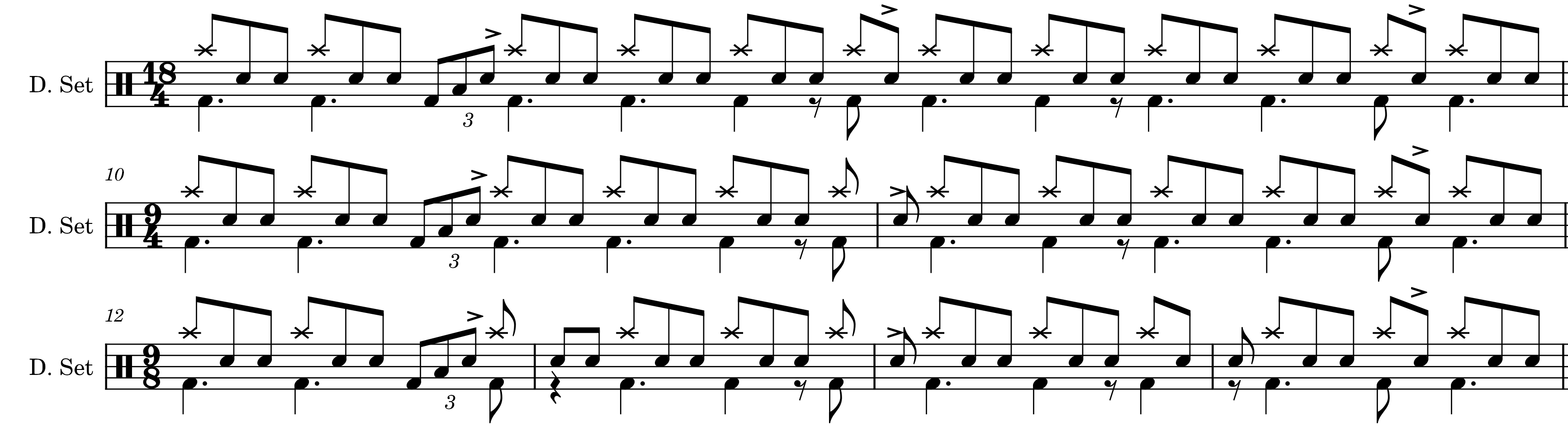
None of those look particularly tidy..
Maybe each phrase has its own time signature, so something like this?

But having over 300 time signature changes in the song is a bit absurd no matter who you are.
If you know something about Meshuggah you will probably say ‘It’s in 4/4, Meshuggah is always in 4/4’, and then grin real smugly.

However, I strongly argue that saying ‘all Meshuggah is in 4/4’ is reductive, and not helpful in learning and understanding how to play these parts.
Knowledge is knowing a tomato is a fruit. Wisdom is knowing to not put it in a fruit salad.
While Clockworks is structured in 4/4 and this intro is exactly sixteen 4/4 bars long, counting in fours is not going to be helpful in learning or performing it.
So I’ve chosen to transcribe the drums in this way:

All bars of 4/4 and an incomplete bar with only 2 beats at the end which then repeat.
Which is the kind of compromise that leaves both sides extremely dissatisfied, but I genuinely think this method preserves the fact the song is in 4/4 while acknowledging the reality that it doesn’t feel like that when we play it.
Polyrhythms make notation complicated, and sometimes a bad choice ends up being your only choice ¯\_ (ツ)_/¯
If you are unhappy with my approach to transcribing Meshuggah, you can fill in a complaint form here:
Right, lets get back to the other half of the intro.
This pattern has the same grouping as the intro, with threes, twos, and a single triplet (also a two).

But there is some funky sticking happening here at the same time which is worth unpacking to get a solid feel for the beat.
The predominant pattern is this kick-tom-snare group of three eighth notes, which is intuitively played Kick-Right-Left, and the triplet is the the same thing but triplet-y.

That takes care of the first chunk of the beat, but then we are thrown a backwards version of our group of three, kick-snare-tom, played kick-left-right.

A bit unexpected but nothing too difficult, then we have a couple of groups containing accented snares; one with two eighth notes, and the other with three.

And everything after the triplet then repeats to give us the complete sequence.

It is very important these accented snares stand out, so hit them extra hard of emphasis.
It can be tricky to get the feel of this sequence of groups, so lets break this down into some chunks we can manageably practice.
The first couple of groups are pretty simple if you are confident moving between the groups of straight eighths and the triplet, but once we encounter the backwards kick-snare-low pattern and then the accents it can feel complicated.
Start by practicing the backwards pattern and the group of two eighth notes with the accented snare.
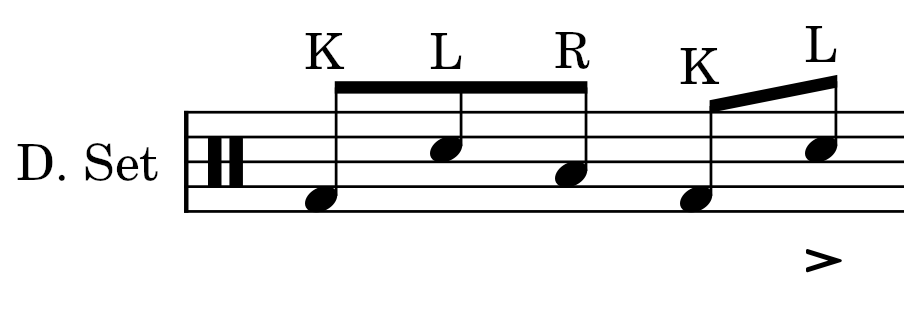
Once you feel confident, add the next group of three eighths with the accented snare.
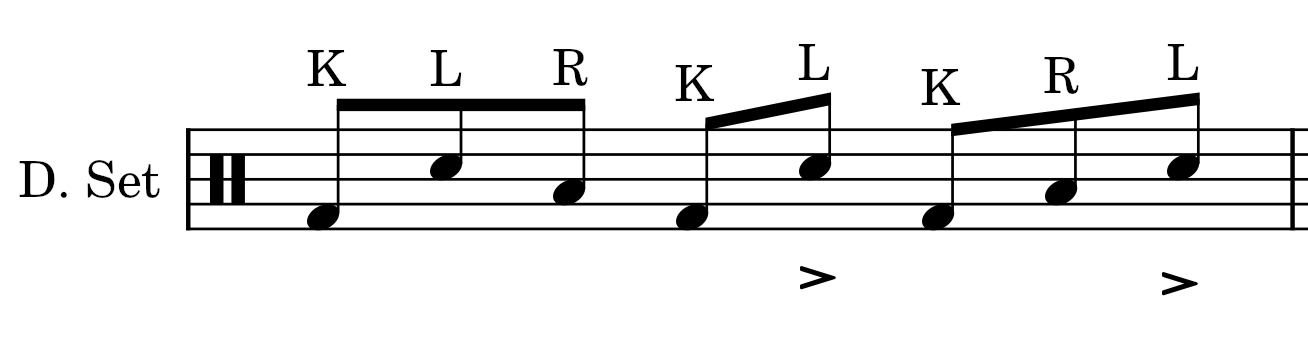
You might be surprised how easily this comes together, there is something really natural-feeling about this pattern once you’ve done it a few times. Remember to hit those accents hard.
Next step is to add the two regular groups of three in front of the pattern.

And then repeat all of that.

It can be helpful and very fun to just repeat these pattern a bunch of times so they feel fast and confident, then add the groups of three and the triplet in front of it all and repeat the sequence.

And that’s it!
If you want to compress this down to something memorisable, the sequence is always two groups of three eighths - kick-tom-snare kick-tom-snare - and then either the triplet or the backwards group of three plus the accents.
If that sounds confusing, its like this:

After you have those two riffs down there are some fills which cut off the riffs at slightly unexpected points, but if you have the beats down, you won’t have any trouble adding them in.
And that’s the intro to Clockworks!
If you would like to see a breakdown of the rest of the song, comment below!
If you liked this breakdown, the best thing you can do is share DrumStickler with your friends. The more people who sign up to the newsletter, the more regularly I can create these breakdowns and do more transcriptions!
Leave a comment below of any songs you would like to see a breakdown of or full sheet music for. If you comment it, I will almost certainly create it!
If you are after other drum transcriptions you can visit my website ajsmusictutoring.com to see what I have released so far, and I also offer transcription lessons if you would like to take your skills to the next level.
Thanks for reading, subscribe for more very soon!
AJ